
Mathematics
Curriculum Intent
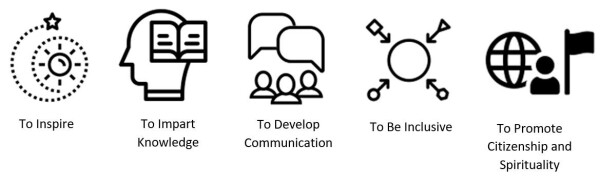
Inspire: Motivate children to enjoy maths, embrace challenge, and see mistakes as part of learning.
Impart knowledge: Build strong foundations for fluency, reasoning, and problem-solving through clear progression and retrieval practice.
Develop communication: Enable children to confidently explain reasoning using precise mathematical language.
Inclusivity: Ensure all pupils progress at the same pace with scaffolding, pre-teaching, and tailored support.
Promote citizenship and spirituality: Encourage creativity, reflection, and participation in real-life contexts and global events.
Curriculum Implementation
Curriculum Structure
Nursery: Uses Master the Curriculum scheme focusing on early number foundations and progression into Reception.
Reception: Combines Mastering Number (NCETM) for number sense and Master the Curriculum for other areas, ensuring small-step progression and conceptual understanding.
Year 1: Continues Mastering Number for number fluency in addition to White Rose Maths units.
Year 2: Fully transitions to White Rose Maths, embedding mastery principles.
Key Stage 2:All year groups follow White Rose Maths, applying the Concrete–Pictorial–Abstract (CPA) approach to deepen conceptual understanding.
Lesson Design
Maths Recall Starter: Low-stakes retrieval of prior learning to strengthen long-term memory.
Pre-requisite Check: Secure foundational knowledge before introducing new concepts.
Explicit Teaching: Short, clear steps with modelled examples and predicted misconceptions addressed upfront.
Guided Practice: Collaborative or independent tasks using carefully chosen examples.
Use of Manipulatives: Concrete resources (e.g., dienes, counters) followed by pictorial and abstract representations.
Assessment and Feedback: In-the-moment feedback and oral corrections to address misconceptions immediately.
Curriculum Impact
Pupil voice and work evidence show strong engagement, enjoyment, and retention of learning. Students use subject-specific vocabulary confidently and produce high-quality, age-appropriate work. Children complete end of unit assessments and end of term assessments.